Key Takeaways
- Asia Pacific faces a $1.5 trillion annual SDG financing gap, yet investor appetite for impact is stronger than ever.
- Impact investing is growing fast, with AUM reaching $79.6 billion between 2019 and 2024.
- Regional fragmentation, weak project pipelines, inconsistent measurement, and blended-finance complexities continue to hold the market back.
- Renewable energy, sustainable supply chains, financial inclusion and fintech, sustainable infrastructure, quality education, and the marine and ocean economy offer high multiplier effects for both impact and growth.
Asia Pacific sits at the centre of a paradox. On one hand, the region faces a $1.5 trillion annual financing gap to achieve the Sustainable Development Goals (SDGs) by 2030. On the other hand, impact investing interest is surging, as more investors seek opportunities that deliver both financial returns and measurable positive outcomes for people and the planet.
Impact investing refers to deploying capital intentionally to generate social and environmental impact alongside financial returns. Unlike traditional philanthropy, it aims to make positive change sustainable and scalable, aligning market incentives with development priorities.
In recent years, impact-focused assets under management (AUM) in Asia Pacific have expanded rapidly, driven by institutional investors, family offices, and development finance institutions. Yet, while over 80% of investors report that their impact investments meet or exceed their financial expectations, much of this capital remains concentrated in mature markets or low-risk sectors.
The challenge is not a lack of intent or capital, it’s the flow and fit of capital. How can funding move more effectively toward high-impact, underserved sectors and geographies? And what ecosystem conditions are needed to enable that?
To unpack this, it helps to look at the broader picture, how development needs and market potential coexist, yet remain out of sync. The infographic below illustrates this dual reality: despite growing investor appetite and promising market returns, systemic frictions still prevent capital from reaching where it’s needed most.
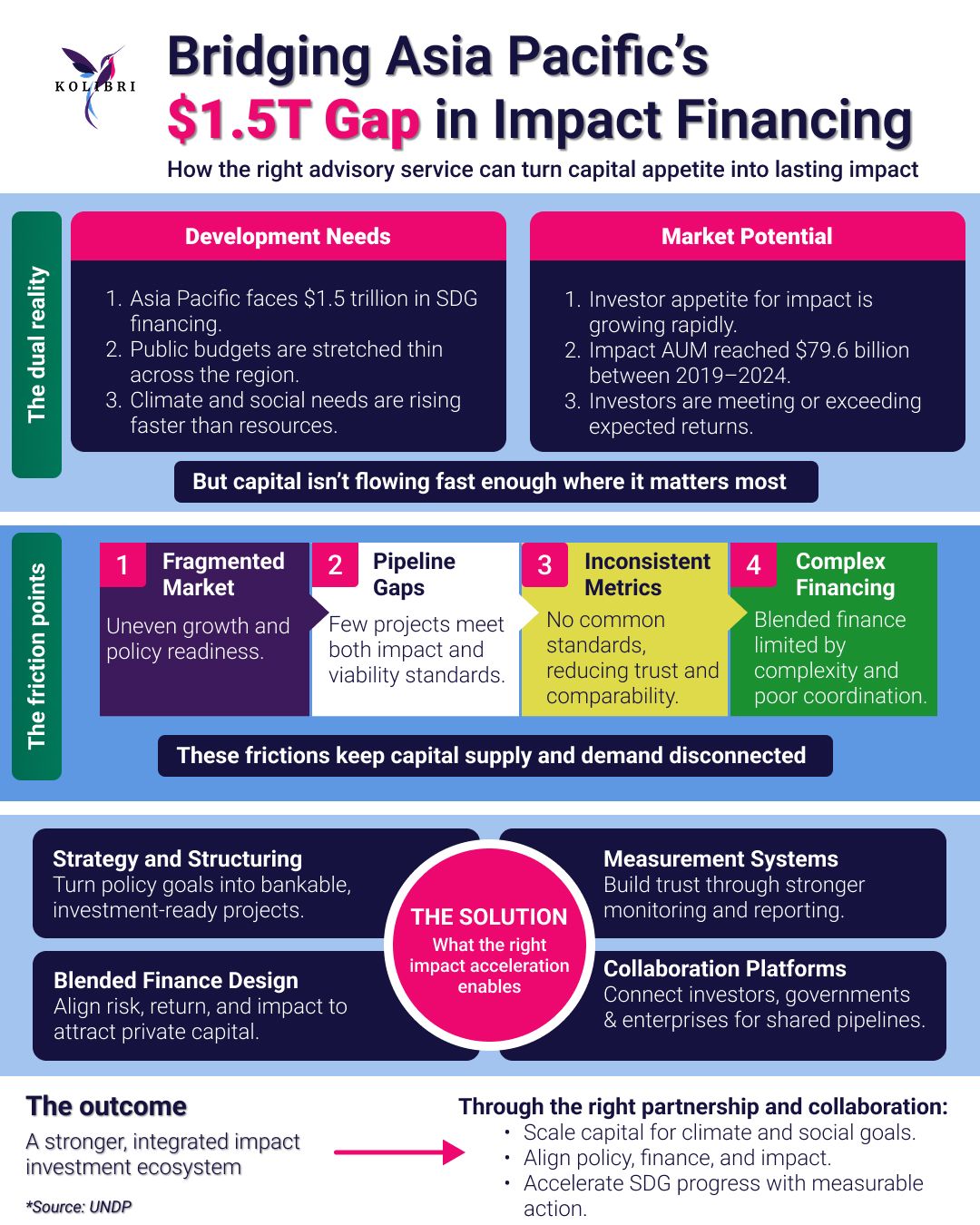
The Growth of Impact Investing in Asia Pacific
Over the past decade, impact investing has moved from the margins to the mainstream in Asia Pacific.
The region is increasingly viewed as a high-growth frontier for impact investing with capital flows expanding across sectors such as renewable energy, financial inclusion, sustainable agriculture, and affordable healthcare. For example, Asia-focused impact investors reported a jump from around USD 50.8 billion in assets allocated in 2019 to USD 79.6 billion in 2024, and industry commentary predicts emerging-market Asia will see faster growth in impact investing over the coming years.
East Asia continues to lead in total assets under management (AUM), driven by large institutional players and growing policy support from governments in China, Japan, and South Korea. Southeast Asia, meanwhile, has seen a steady rise in blended finance structures and catalytic capital, particularly in Indonesia, Vietnam, and the Philippines, as investors test models that combine development impact with commercial returns. South Asia, led by India, remains a pioneer in scalable social enterprises and innovative financing tools.
These regional developments signal a broader shift in mindset: investors are increasingly viewing impact not as a trade-off, but as a source of long-term value creation.
But growth alone isn’t enough, unlocking true impact requires tackling the structural barriers that continue to hold back the market.
Challenges Holding Back the Market
Despite growing investor appetite and rising awareness, Asia Pacific’s $1.5 trillion SDG financing gap remains stubbornly persistent. The issue is not an absence of private capital, it’s the structural frictions that prevent this capital from flowing efficiently into high-impact opportunities.
Four key challenges continue to hold the market back:
1. Fragmented Ecosystem
The impact investment landscape remains highly fragmented, with limited coordination among investors, policymakers, and intermediaries. Many initiatives operate in silos, duplicating efforts rather than building shared infrastructure for knowledge, risk mitigation, and market access.
2. Limited Investment Pipeline
While investor interest is strong, the supply of investment-ready enterprises remains thin. Many social enterprises and SMEs struggle to meet the financial, operational, or reporting standards required by institutional investors, creating a persistent mismatch between available capital and investable opportunities.
3. Inconsistent Impact Measurement
Despite progress, there is still no universal framework for measuring and reporting impact. This lack of consistency makes it difficult for investors to compare opportunities or aggregate results, weakening accountability and trust across the market.
4. Complexity in Blended Finance
Blended finance, meaning the strategic use of concessional funds to mobilise private capital, holds significant promise but remains underutilised and overly complex. Structuring such deals often requires high transaction costs, specialised expertise, and patient coordination between public and private actors.
These challenges reinforce one another, creating a cycle of inefficiency where private capital sits on the sidelines and impactful enterprises remain underfunded. Overcoming them requires more than enthusiasm, it calls for strategic advisory support that can bridge intent with execution.
Why the Right Strategy and Advisory Support Matter
Bridging the gap between investor intent and real-world impact requires more than capital, it demands strategy, structure, and stewardship. This is where impact investment advisory and sustainable development consulting play a pivotal role.
Advisory partners help turn broad policy ambitions and ESG commitments into bankable, high-impact projects by addressing three critical needs:
1. Translating Policy into Actionable Pipelines
Governments across Asia Pacific are announcing ambitious sustainability roadmaps, from green industrial strategies to inclusive finance frameworks. Advisors help these translate into viable, investment-ready projects, connecting national priorities with investor appetite.
2. Designing and Structuring Blended Finance
By combining public, philanthropic, and private capital, blended finance can make otherwise risky projects feasible. Advisory firms design structures that balance returns with impact, helping to de-risk early-stage investments and crowd in private capital where it matters most.
3. Building Measurement, Evaluation, and Learning Systems
Standardized and investor-grade impact measurement is essential for credibility and scale. Advisory support ensures that projects not only deliver impact but can prove and communicate it, increasing transparency, trust, and replicability across the region.
4. Enabling Collaboration Across Stakeholders
From DFIs and NGOs to local entrepreneurs and investors, the ecosystem thrives on collaboration. Advisors serve as neutral conveners, aligning diverse stakeholders behind shared goals and evidence-based strategies.
Together, these functions make advisory services the connective tissue of Asia Pacific’s impact ecosystem, linking capital, policy, and execution.
Case Example
Indonesia's government, DFIs and private investors have come together through blended finance pacakges (such as a USD 2.128 billion program approved by the Word Bank in 2025) that include expected private-investment mobilization of USD 345 million.
Lesson
While not limited to off-grid solar, this illustrates how strategic structuring can unlock large-scale private capital for sustainable infrastructure.
Where the Biggest Opportunities Lie
Across Asia Pacific, the opportunities for impact investing are as diverse as the region itself. But certain sectors stand out, where well-structured investments can generate outsized social, environmental, and economic returns.
Here are six priority sectors where advisory and strategy support can make the biggest difference:
1. Renewable Energy
With energy demand expected to double by 2040, Asia needs more clean power, fast. Every $1 invested in renewable energy generates up to $3 in long-term economic benefits, from job creation to improved air quality. Advisory support helps governments and investors structure bankable renewable portfolios, reducing risk through blended finance.
2. Sustainable Supply Chains
Asia drives much of the world’s manufacturing output, but supply chains face growing pressure to meet ESG standards. Strategic advisory enables companies to embed sustainability into procurement, traceability, and logistics, turning compliance into competitiveness.
3. Financial Inclusion and Fintech
Over 1 billion people in Asia still lack access to formal financial services. Fintech innovation, supported by enabling policy frameworks and impact finance, can bridge this gap. Advisors help align inclusion goals with viable business models, ensuring that digital finance growth translates to real social outcomes.
4. Sustainable Infrastructure
Asia’s infrastructure needs are estimated at over $1.7 trillion per year. Investing in resilient, low-carbon infrastructure not only drives GDP growth but also reduces vulnerability to climate shocks. Advisory firms play a key role in preparing projects, structuring finance, and integrating climate resilience into infrastructure planning.
5. Quality Education and Skills Development
As Asia’s economies digitalize, demand for future-ready skills is surging. Impact capital can strengthen TVET programs, edtech platforms, and workforce transition initiatives. Advisory support ensures alignment between investors, governments, and educators, creating scalable models for human capital growth.
6. Marine and Ocean Economy
Home to over half of the world’s coastal population, Asia’s oceans are both a vital resource and a shared vulnerability. Investments in sustainable fisheries, coastal protection, and blue carbon projects can yield high-impact returns. Advisors help design financing mechanisms that value ecosystem services and attract private investors to the blue economy.
Together, these sectors represent the frontlines of Asia’s sustainable transformation. Targeted advisory can accelerate capital deployment, reduce transaction costs, and ensure that impact is measurable, not just aspirational.
The Bigger Picture: Building a Stronger Impact Investment Ecosystem
As Asia Pacific’s impact sectors mature, the next frontier lies not just in funding more projects, but in building stronger systems. The region’s challenge is to connect the dots between capital, capacity, and coordination.
Advisory firms play a pivotal role in strengthening this ecosystem from the ground up, creating the conditions for scale and resilience.
1. Standardizing Frameworks and Metrics
A shared language for impact is essential. Advisors help align measurement and reporting practices across governments, investors, and enterprises, advancing the use of global standards like IRIS+ and SDG-aligned indicators. This consistency builds trust, comparability, and cross-border capital flows.
2. Building Efficient Market Matchmaking
Impact investing thrives on connections between investors seeking returns and enterprises seeking growth. Advisory-led platforms and databases can match capital with credible opportunities, reducing transaction costs and accelerating deal flow.
3. Strengthening Public-Private Collaboration
Public policy and private investment must move in tandem. Advisors help governments design investment facilitation mechanisms, such as national impact funds, blended finance facilities, and de-risking instruments that attract institutional investors into priority sectors.
4. Diversifying the Impact Capital Base
To close the $1.5 trillion gap, Asia must mobilize not just global investors, but also local financial institutions, family offices, and pension funds. Advisory partners design entry points for these actors, expanding the pool of impact-oriented capital.
The result is a more cohesive, transparent, and scalable impact investment ecosystem, one where good projects don’t stall for lack of structure, and capital flows confidently toward measurable outcomes.
Together, these ecosystem enablers turn fragmented markets into functioning systems, the foundation on which Asia Pacific’s next wave of sustainable growth will be built.
From Appetite to Action
The momentum for impact investing in Asia Pacific is real, but momentum alone doesn’t build systems. Real progress depends on translating growing investor appetite into actionable, coordinated solutions across public, private, and philanthropic sectors.
That’s where Kolibri for Impact comes in.
As a strategy and advisory firm, we operate at the intersection of policy, capital, and implementation, helping partners design pathways that align financial performance with social and environmental outcomes. Our work focuses on embedding Risk Sustainability Impact (RSI) frameworks that enable decision-makers to evaluate opportunities not just by profit potential, but by long-term resilience and value creation.
Through tri-sector collaboration, we support:
- Governments and multilaterals in shaping enabling policies and blended-finance mechanisms that attract private capital.
- Private investors and businesses in identifying high-impact, investment-ready projects aligned with their sustainability objectives.
- Philanthropic actors in using catalytic capital to de-risk early-stage or frontier opportunities that advance SDG outcomes.
By bridging these actors, we help move the region from fragmented efforts to systemic transformation, turning capital into lasting impact.
Together, we can strengthen Asia Pacific’s impact investment ecosystem, one where collaboration, consistency, and capital work hand in hand to deliver a sustainable future.
If your organisation is looking to design strategies, structure investments, or accelerate impact across the region, get in touch with us. Let’s turn capital into long-term change.
About the Authors
This article is a collaborative effort by Dhia Fani, Vera Harludi, Tifani Lusiana, Irfan Fahmi, representing Kolibri for Impact Strategy practice.